
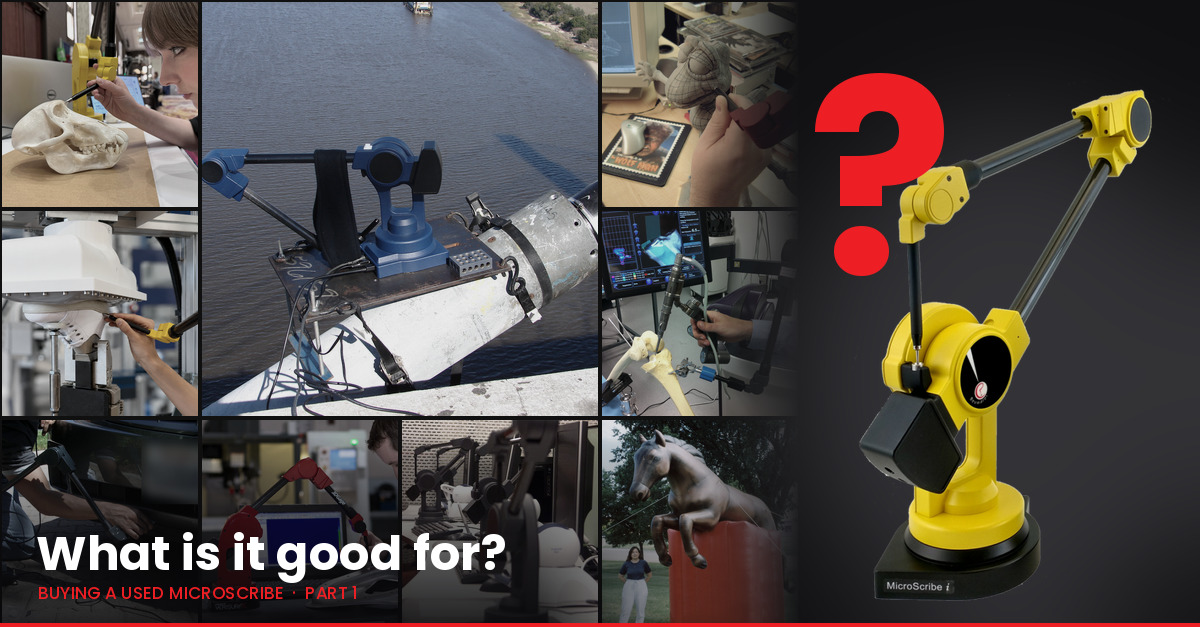
A MicroScribe has worked in forensic labs, race shops, animation studios, and on top of a suspension bridge. Before asking whether a used arm still works, it is worth asking whether a MicroScribe fits your work at all.
What is a MicroScribe good for?
It sounds like the easiest question I get. After thirty years, I think it is the hardest.
A MicroScribe has measured skulls to repatriate remains and suspensions in race shops. It has turned clay maquettes into familiar animated characters, taught robots their paths, and set reference frames for guided surgical procedures. MicroScribes have been in labs, workshops, on top of suspension bridges, deep within the crawlspaces of a Navy vessel, and at Machu Picchu. When one tool fits that many jobs and travels that easily, saying what it is for gets harder, not easier. Choosing a focus among all of them has been one of our biggest marketing challenges.
Here is the answer underneath them all. A MicroScribe is at its best doing four things:
- Measuring landmarks: isolated 3D points in space, like robotic go-to positions or suture intersections on a human skull
- Measuring prismatic forms: the planes, cylinders, and edges that define physical parts or the boundaries of negative space
- Tracking live motion: where the stylus is and how it is oriented, continuously, in real time
- Going where the work is: taking precision to the job
Those four abilities explain where you find it:
- Mechanical reverse engineering, turning a physical part into a CAD model you can change
- Manufacturing inspection, where the goal is to assess deviation from design dimensions
- Scientific data collection for morphological and forensic analysis
- Robot teaching and validation
- Establishing a coordinate reference frame and tracking movement within it, our major contribution to guided surgical systems
- Showing up in unusual places, right at the source of the data that drives understanding and innovation
It may not be the best tool if you need every point on an organic surface; today a scanner usually does that better, as I wrote in “Intentional”.
But organic shapes are often defined by a few curves. One company that manufactures parade balloons digitizes their designs with a MicroScribe, capturing only the seam lines between panels on clay mockups. Edges and drive curves are all they need.
If your tolerances are tighter than the arm’s accuracy, you need a different class of instrument, but we are closing that gap with every new iteration. Large items outside the reach of the arm present a challenge, but standard methods such as leapfrogging expand the reach within reason.
Why mention this now? This starts a short series for anyone looking at a used MicroScribe: the one on eBay, the one from a lab cleanout, the one inherited from a retiring colleague. Before asking whether a particular arm still works, it is worth asking whether a MicroScribe fits your work at all. Next week: is it alive?
A complete guide is in the works.
What do you use yours for? The answers still surprise me.
About Revware
Revware provides high, quality, simple to use, innovative, cost-effective modeling solutions to solve your design, metrology, and engineering problems.