
A listing that just says “MicroScribe” could describe arms built years apart. Here is how to tell which one you are looking at, even when the label is long gone, and why it matters before you buy.
Two weeks ago I asked whether a used MicroScribe is still alive. Before you can judge an arm, you need to know which one it is. A listing that just says “MicroScribe” could describe arms built years apart, with different electronics, connections, and power needs.
Start with the labels.
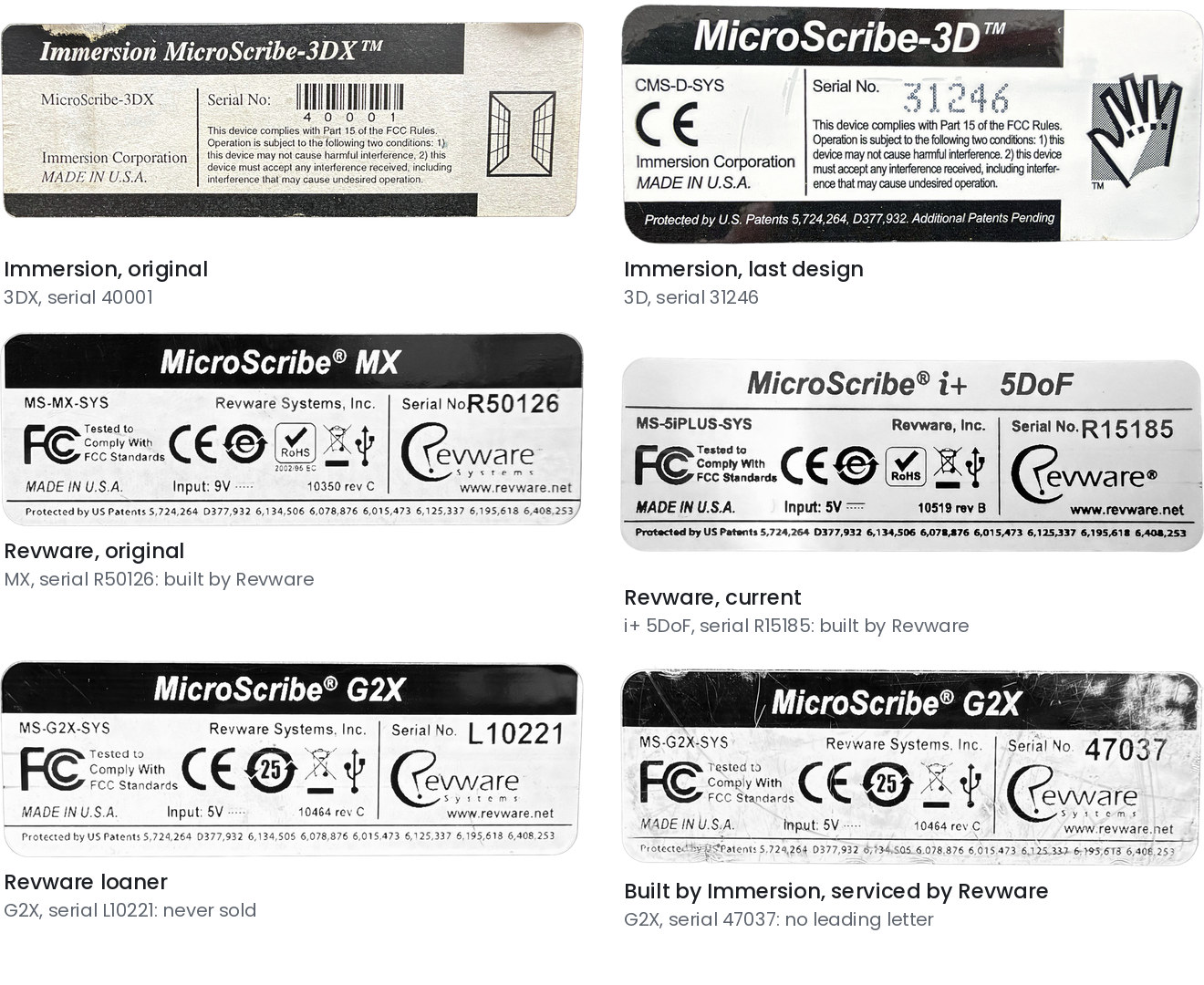
- A label on the front of the base names the model family. On early arms these labels came off easily.
- A tag on the bottom plate, under the base, identifies the specific model and carries the serial number. It can be scratched beyond recognition.
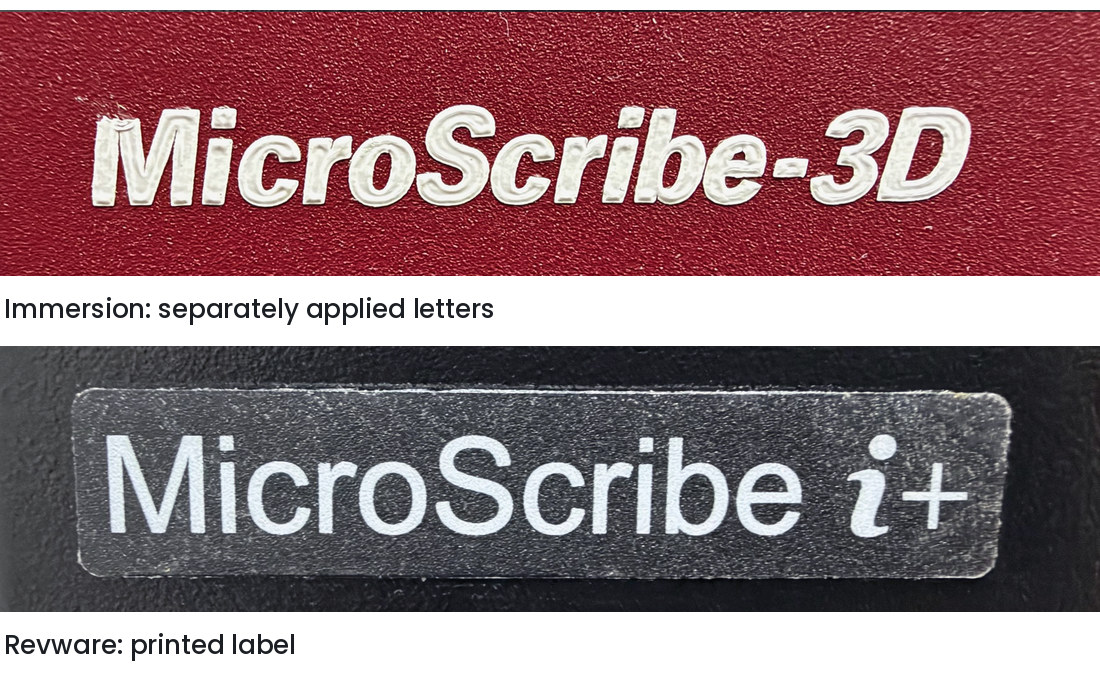
Immersion, which built the early arms, used a front label made of separately applied letters. They tended to fall off one at a time, so most Immersion arms are missing a few letters, or all of them. Revware has always used a printed label.
Then look at the color. Usually:
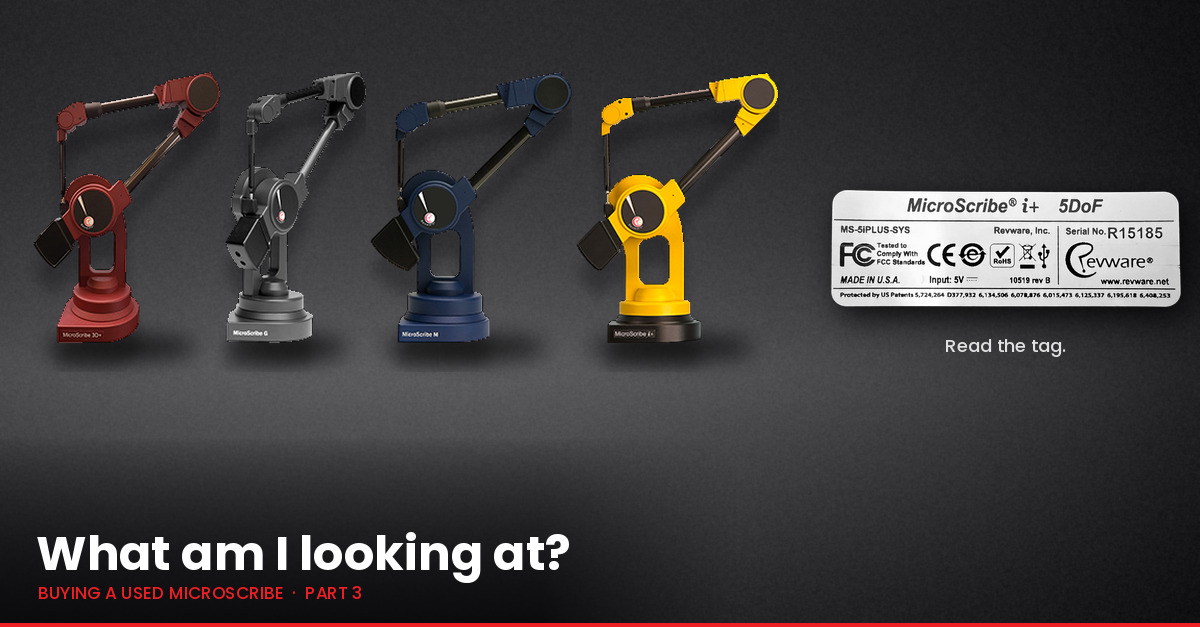
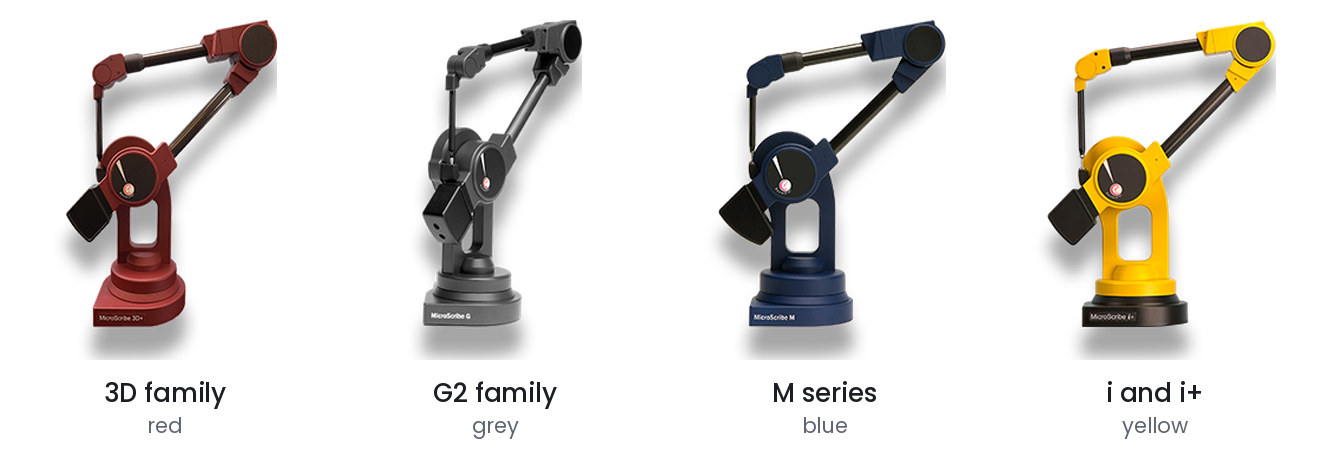
- Red, anodized or a duller red powder coat: 3D family
- Grey: G2 family
- Blue: M series
- Yellow: i and i+, which look identical apart from the front label and the ports on the back
Any other color, such as white, black, or one of several anodized finishes, means a custom arm, built for a volume customer or as a short-run sample. Color is a clue, not proof.
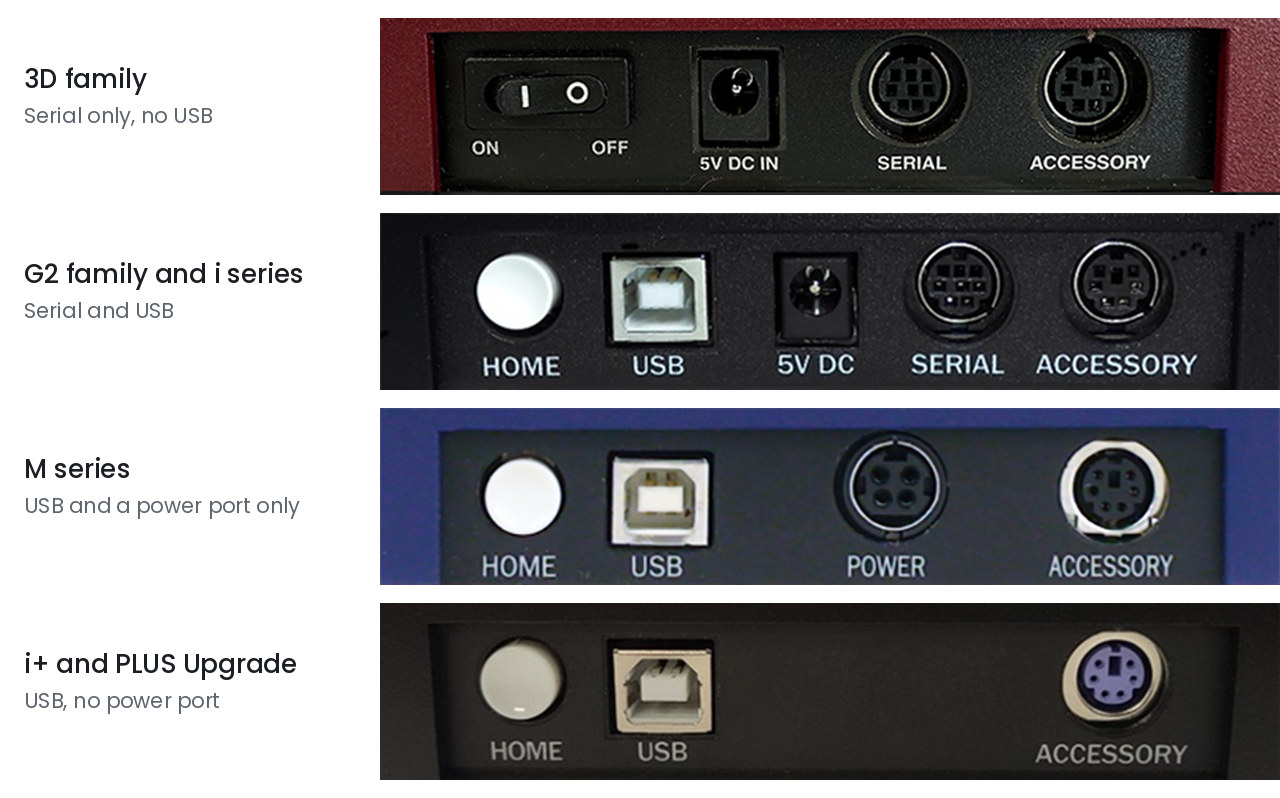
The back of the base is more reliable. Look at the ports:
- Serial only, no USB: 3D family
- Serial and USB: G2 family or i series
- USB and a power port only: M series
- USB with no power port: an i+, or an older arm that has had our PLUS Upgrade, which gets the same main board
The best answer comes from the arm itself. If it powers up, the MicroScribe Arm Tester names the model at the top of the screen, and the Info option in MUS reports it too. An arm with the PLUS Upgrade reports itself as a 3D+, G+, or i+ (an upgraded i becomes an i+).
Reading the name:
- X marked the better performers. Immersion tested each arm coming off the line and graded it, much as chip makers grade processors. A 3DX or G2X tested better than a 3D or G2. Every M series arm is an MX.
- L means long. A G2X has the standard 25-inch reach; a G2LX reaches 33 inches.
- The i series dropped the X. It shares the G2X architecture, with higher accuracy components. The i+ was redesigned throughout, with better components and a new main board.
Reading the serial number:
- A leading R: built by Revware.
- A leading L: a Revware loaner. Loaners are never sold and remain Revware property. If you see one for sale, please contact us.
- No letter: built by Immersion. If that arm carries a Revware tag, we have serviced it.
Why does it matter? The model tells you the arm’s era, which power supply it needs, whether you will need a serial adapter for a modern computer, and which service and upgrade paths are open to it. Each new model brought gains in accuracy and usability. The M series and the i+ share the same specified accuracy, but the i+ is a little more accurate, lighter, and easier to handle, and its new electronics make it much faster. They also make it a far more capable development platform for us and for the companies that build MicroScribe into their own products.
When each family arrived:
| Family | First appeared | Usual color | Ports on the back |
|---|---|---|---|
| 3D (3D, 3DX) | April 9, 1995, introduced at the National Association of Broadcasters show | Red | Serial, no USB |
| G2 (G2, G2X, G2L, G2LX) | July 19, 2002, first sold | Grey | Serial and USB |
| M series (MX) | December 16, 2004, first sold | Blue | USB and a power port |
| i series | February 21, 2017, first sold | Yellow | Serial and USB |
| i+ | October 11, 2021, first sold | Yellow | USB, no power port |
Next time: what to check before you pay.
About Revware
Revware provides high, quality, simple to use, innovative, cost-effective modeling solutions to solve your design, metrology, and engineering problems.